
On the East Coast of the United States, some species of fish are already experiencing climate-related shifts in distribution, abundance, and productivity. Although the future is uncertain, a continuation or acceleration of climate change has the potential to strain our existing fishery management system and alter the way fishermen, scientists, and the public interact with the marine environment.
In order to begin preparing for this possibility, management bodies along the entire Atlantic seaboard have teamed up to launch a new project called East Coast Climate Change Scenario Planning. Scenario planning is a way of exploring how fishery management may need to evolve over the next few decades in response to climate change. You can find additional details in the introductory brochure.
Weigh In! Stakeholder Input is Key to Effective Scenario Planning
The initiative is being organized by a Core Team of representatives from the New England, Mid-Atlantic, and South Atlantic Fishery Management Councils, the Atlantic States Marine Fisheries Commission, and NOAA Fisheries. The team has lined up three kick-off webinars:
Monday, August 30, 4:00 – 5:30 p.m.
Wednesday, September 1, 6:00 – 7:30 p.m.
Thursday, September 2, 10:00 – 11:30 a.m.
Please register at the links above. The webinars will introduce stakeholders to the overall initiative, explain the benefits of participating in the process, outline additional ways to become involved, and begin collecting stakeholder input.
On the East Coast of the United States, some species of fish are already experiencing climate-related shifts in distribution, abundance, and productivity. Although the future is uncertain, a continuation or acceleration of climate change has the potential to strain our existing fishery management system and alter the way fishermen, scientists, and the public interact with the marine environment.
In order to begin preparing for this possibility, management bodies along the entire Atlantic seaboard have teamed up to launch a new project called East Coast Climate Change Scenario Planning. Scenario planning is a way of exploring how fishery management may need to evolve over the next few decades in response to climate change. You can find additional details in the introductory brochure.
Weigh In! Stakeholder Input is Key to Effective Scenario Planning
The initiative is being organized by a Core Team of representatives from the New England, Mid-Atlantic, and South Atlantic Fishery Management Councils, the Atlantic States Marine Fisheries Commission, and NOAA Fisheries. The team has lined up three kick-off webinars:
Monday, August 30, 4:00 – 5:30 p.m.
Wednesday, September 1, 6:00 – 7:30 p.m.
Thursday, September 2, 10:00 – 11:30 a.m.
Please register at the links above. The webinars will introduce stakeholders to the overall initiative, explain the benefits of participating in the process, outline additional ways to become involved, and begin collecting stakeholder input.
Members of the public are invited to join a Port Access Route Studies Update & Map Data webinar on Sept. 14, at 10 a.m. In this special edition of the Mid-Atlantic Ocean Data Portal’s “How Tuesday” webinar series, presented in partnership with the Coast Guard and Northeast Regional Ocean Council, Coast Guard personnel will present information on findings, public comment opportunities and next steps for two draft reports for Port Access Route Studies focused on the approaches to the Chesapeake Bay in Virginia (CHESPARS) and the Northern New York Bight (NNYBPARS). In addition, demonstrations will be provided for publicly available tools and map data that can be used to explore the studies and their proposed routing measures in further depth.

The next meeting of the Responsible Offshore Science Alliance Advisory Council, which will be open to the public, will take place on September 24th from 1-4 pm EST. The meeting summary and presentations from the June 17th meeting can be found on the Advisory Council page of the website, and the agenda for the September meeting will be posted on this page a few weeks before the meeting.
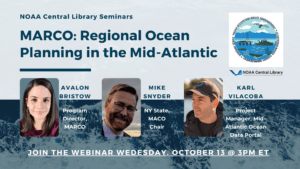
Join us for another NMFS Ecosystem Based Management/Ecosystem Based Fishery Management Seminar Series (EBM/EBFM)!
Presenters: Avalon Bristow, Program Director, MARCO; Mike Snyder, New York State Department of State, Steering Comm. Chair of Mid-Atlantic Committee on the Ocean; Karl Vilacoba, Urban Coast Institute’s Communications Director & Communications Lead/Project Manager for the Mid-Atlantic Ocean Data Portal
Abstract: The Mid-Atlantic Regional Council on the Ocean (MARCO) is the Regional Ocean Partnership for the Mid-Atlantic. MARCO has been coordinating across geographies and agencies around shared ocean priorities since 2009 when it was established by the governors of the five coastal Mid-Atlantic states – VA, MD, DE, NJ, and NY. In 2018, MARCO established the Mid-Atlantic Committee on the Ocean (MACO) to foster collaboration among states, federal agencies, the Mid-Atlantic Fishery Management Council (MAFMC), and federally recognized tribes, and to engage stakeholders. We will provide an update about ocean planning activities in the Mid-Atlantic, with a special focus on the region’s five topic-specific working groups and the Mid-Atlantic Ocean Data Portal.
About the Speakers
Avalon Bristow is Program Director at MARCO, where she works closely with the Board to develop and implement actions that advance MARCO’s priorities. She is staff support to MARCO’s collaborative work groups, is Co-Coordinator of the Mid-Atlantic Coastal Acidification Network in partnership with MARACOOS, and is Coordinator for the Regional Wildlife Science Entity in partnership with the Northeast Regional Ocean Council. Prior to joining MARCO, Avalon worked as a Program Manager for National Wildlife Federation’s Mid-Atlantic office, where she coordinated their coastal resilience and conservation education programs.
Mike Snyder is the Ocean and Great Lakes Program Manager at the New York State Department of State. He is currently a MARCO Management Board member and the Steering Committee Chair for the Mid-Atlantic Committee on the Ocean (MACO). Since joining the Department in 2008, Mike has been actively involved in advancing New York’s Ocean and Great Lakes policy agenda, including contributing to regulatory reviews of energy projects in the Offshore Atlantic, helping to create the Five-State Mid Atlantic Regional Council on the Ocean (MARCO), and coordinating State agency participation in the BOEM-New York Offshore Renewable Energy Task Force.
Karl Vilacoba is the Urban Coast Institute’s Communications Director and the communications lead/project manager for the Mid-Atlantic Ocean Data Portal. Prior to joining the UCI, Karl worked for the North Jersey Transportation Planning Authority, where he oversaw a variety of public outreach efforts and served as managing editor of InTransition, a national transportation magazine published in partnership with the New Jersey Institute of Technology. Karl previously spent a decade as a news reporter and editor for newspapers in the Jersey Shore area and at USA Today’s Manhattan Bureau. A lifelong Shore resident, Karl also served for several years as a member of the Lake Como Unified Planning & Zoning Board and the borough’s Environmental Commission.
POC: Peg Brady (peg.brady@noaa.gov); Library Seminars (library.seminars@noaa.gov)
Registration: https://register.gotowebinar.com/register/4462794963967362828
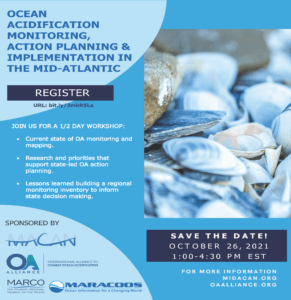
Supporting OA Action Planning and Implementation in the Mid-Atlantic
Mid Atlantic Coastal Acidification Network (MACAN) and OA Alliance Virtual Workshop
October 26
1:00 PM – 4:30 PM EST
(3.5 hours in duration)
The majority of the Mid-Atlantic coastal states are pursuing OA Action Planning either as stand-alone efforts or as part of broader coastal/ocean planning efforts. This workshop seeks to connect researchers, state agencies, and/or representatives from state legislatures from across the Mid-Atlantic region to help inform OA Action planning with an emphasis on identifying associated data/ information needs for management and coordinating monitoring where appropriate.
AGENDA
REGISTER
https://bit.ly/3mkR5Le
In person at the Westin Annapolis (100 Westgate Circle Annapolis, MD 21401) and online via Webex webinar.
This meeting will be conducted as a hybrid meeting. Council members, other meeting participants, and members of the public will have the option to participate in person at the Westin Annapolis or virtually via Webex webinar. Both virtual attendees and those attending the meeting in person will use the “raise hand” function in Webex to comment, ask questions, make motions, and vote. We are recommending that all in-person attendees either be vaccinated or receive a negative COVID test prior to meeting attendance. We are also encouraging attendees to wear a mask when moving around the hotel and meeting space.
Webinar Information
The virtual portion of the meeting will be conducted via Webex webinar. No pre-registration is required. The webinar link will be the same for all four meeting days.
-
Click here to join the webinar (if prompted, enter meeting number: 2330 933 4966; Meeting password: ncKMj56xX6p)
-
Join by phone: For those who will not be joining the webinar but would like to listen in to the audio portion only, dial 1-415-655-0001 and enter access code: 2330 933 4966#). When asked for your attendee ID, enter #. Participants connected by phone only will need to enter *6 on their keypad to unmute/mute themselves and *3 to raise/lower their hands.
-
Need Help? If you need technical assistance, please check the Webex Participant Guide. For further assistance, contact Mary Sabo at msabo@mafmc.org or 302-518-1143 (call or text).
We will also be live streaming the meeting to our YouTube channel.
Ocean acidification has subtle and complicated effects on fish because it often affects only the earliest life stages and interacts with other stressors. This project pulled together several types of data from multistressor experiments on Atlantic silversides, an abundant fish along the East Coast, to model their energy budget throughout the life cycle. Using Dynamic Energy Budget theory (DEB) we are able to incorporate different effects at each life stage to reflect the increased tolerance adults have relative to embryos and larvae. Energy budgets can help us test hypotheses about how energy is allocated to needs like homeostasis and reproduction under acidification, and ultimately estimate population-level effects.
Using Gene Silencing to Validate the Role of Perlucin Gene in Oyster Resilience to Ocean Acidification
Caroline Schwaner, Stony Brook University
We previously investigated the molecular mechanisms associated with resilience to ocean acidification in Crassostrea virginica. There were significant differences in SNP and gene expression profiles among oysters reared under normal and OA conditions. Both of these approaches showed similar results, particularly in genes related to biomineralization, including perlucin. In this study, we used RNAi or gene silencing to validate findings and confirm the protective role of perlucin associated with resilience to OA. Silenced oysters under acidification stress were the smallest, had shell abnormalities, and had significantly reduced shell mineralization, thereby indicating that perlucin does help larvae mitigate the effect of OA.
Impacts of extreme events on carbonate system variability in the York River Estuary: a numerical model study
Fei Da, Virginia Institute of Marine Science
Better understanding the carbonate system variability during extreme events will help predict future changes and provide critical information for the local shellfish aquaculture industry. In this study, a coupled hydrodynamic-biogeochemical 3-D high-resolution model is used to investigate the primary controls of the carbonate system in a small sub-estuary of the Chesapeake Bay: the York River Estuary. Net horizontal advection, air-sea CO2 flux, and net community production all play crucial roles in controlling dissolved inorganic carbon (DIC) and pH, while total alkalinity is relatively conservative. During extreme high discharge events, pH reductions are associated with net heterotrophy and net advection of high DIC upstream water, with increased outgassing playing a counteracting role.
Influence of water quality history on future ocean acidification tolerance in larval eastern oysters in Chesapeake Bay
Anthony Himes, Virginia Institute of Marine Science
One species of calcifying organisms that could be pushed beyond their physiological limits due to future acidification is the eastern oyster, C. virginica, which provides the basis for an expanding aquaculture industry. Previous studies have shown that oyster larvae are negatively impacted by acidification, but less is known about what level of acidification initiates a stress response and how well larvae can modulate these mechanisms. Additionally, little is known about potential differences in stress tolerance among different oyster populations. Therefore, larvae were compared between two different reefs within Chesapeake Bay to assess the hypothesis that reefs exposed to lower salinity conditions will be more tolerant to future acidification due to overlap in the cellular mechanisms responsible for osmoregulation and acid-base regulation.
Development and applications of pH glider technology in the Mid-Atlantic Bight
Liza Wright-Fairbanks, Sea Grant Knauss Fellow, NOAA OAP
Currently, productive coastal systems lack vertically-resolved high-resolution ocean carbonate system measurements on timescales relevant to organism ecology and life history. To address this issue, a newly developed deep ISFET (Ion Sensitive Field Effect Transistor)-based pH sensor system was modified and integrated into a Slocum G2 profiling glider. From Spring 2018 to Fall 2019, seasonal pH glider deployments were conducted in Atlantic surfclam (Spisula solidissima) and Atlantic sea scallop (Placopecten magellanicus) commercial management zones in the Mid-Atlantic Bight. Here, we present seasonal cycles and drivers of carbonate chemistry in the Mid-Atlantic Bight based on seasonal glider deployments. Additionally, we discuss the use of glider data in conjunction with larval dispersal models to identify times and locations where shellfish stock may be at high risk of acidification.
The Delaware Department of Natural Resources and Environmental Control (DNREC) contracted with Industrial Economics, Incorporated (IEc) and the RPS Group to model possible oil spill scenarios off the Delaware coast and the resulting economic impacts.
In partnership with the Mid-Atlantic Regional Council on the Ocean (MARCO) DNREC is hosting two webinars, March 24 and March 31. that will provide attendees a high-level overview of the report results and an opportunity to ask questions of the IEc and RPS staff who completed the work.
Although the results are Delaware specific DNREC and MARCO are hopeful that the results and processes used in the analysis can be used to support other states in the Mid-Atlantic to conduct their own analyses.
Integrated Oil Spill and Transport Modeling
Thursday, March 24, 2022
11 a.m. to 12 p.m.
The Delaware Department of Natural Resources and Environmental Control (DNREC) contracted with Industrial Economics, Incorporated (IEc) and the RPS Group to model possible oil spill scenarios off the Delaware coast and the resulting economic impacts.
In partnership with the Mid-Atlantic Regional Council on the Ocean (MARCO) DNREC is hosting two webinars, March 24 and March 31. that will provide attendees a high-level overview of the report results and an opportunity to ask questions of the IEc and RPS staff who completed the work.
Although the results are Delaware specific DNREC and MARCO are hopeful that the results and processes used in the analysis can be used to support other states in the Mid-Atlantic to conduct their own analyses.
Economic Impacts from an Offshore Oil Spill
Thursday, March 31, 2022
11 a.m. to 12 p.m.