Learn about regulatory, operational and management characteristics of electricity transmission from offshore wind projects, and the challenges of shifting to a new planning paradigm offshore. Rob Gramlich of Grid Strategies, LLC will provide an overview of how the grid works. Mark Kalpin of Holland & Knight will address regulatory considerations for offshore wind transmission planning.
Other experts have been invited to speak about New Jersey’s recent announcement to align state offshore transmission policy with the grid operator’s planning process. Presentations will be followed by discussion and Q&A.
We invite you to join us April 12, 2021 at 1PM EST for our next webinar, State-Led OA Action Planning in the US Mid-Atlantic.
Co-hosted by the OA Alliance and the Mid-Atlantic Coastal Acidification Network, the 60 minute webinar will dive deeper into specific components of OA Action Planning in Maryland, New Jersey and across U.S. Mid-Atlantic States. Collectively, presentations will touch on partnerships, data, research, projects and policy frameworks that are informing states’ OA Action Plan recommendations.
Please register at: https://register.gotowebinar.com/register/5804464133441407245
After registering, you will receive a confirmation email containing information about joining the webinar.
Monday, May 3, 2021 12:30 – 4:00 PM
Tuesday, May 4, 2021 9:30 AM – 3:00 PM
Wednesday, May 5, 2021 9:15 AM – 1:45 PM
Thursday, May 6, 2021 9:30 AM – 12:30 PM
For more information please visit the Forum web page.
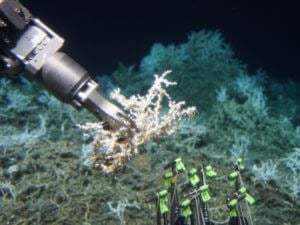
For Ocean Month MARCO is holding a very special webinar with Dr. Carol Anne Clayson and Ryan Gasbarro on climate change and its impacts to our deep sea corals on June 24, 2 – 3 PM.
Dr. Carol Anne Clayson of Woods Hole Oceanographic Institution will talk about air-sea interactions and how climate changes are affecting water movement through the ocean, atmosphere, land and back again, as well as changes in the physical ocean environment and developments to improve predictability for weather and climate information. Mr. Ryan Gasbarro of Temple University will present his current work on creating ensemble habitat suitability models for Lophelia pertusa, and projected distribution and abundance models under four carbon emission scenarios.
Please register at https://attendee.gotowebinar.com/register/5630964498836952080
Are you a newcomer interested in a Portal 101 session or a returning user who could use a refresher course? Then this webinar is for you!
Join us Tuesday, June 29, from 11 a.m. to noon for a #HowTu lesson on our data, tools and features. Come with your list of questions and learn how to map the Mid-Atlantic in this interactive session.
This webinar is free and open to the public. The lesson will be provided via Zoom by Portal team member Karl Vilacoba of Monmouth University’s Urban Coast Institute. To register, please click here.
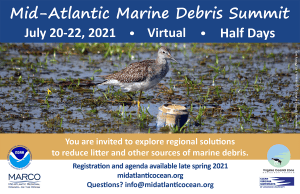
Marine debris is a growing global problem with wide-ranging impacts. Although much remarkable work to prevent and remove marine debris has been done, marine debris, particularly plastics, continues to accumulate in our ocean. This poses problems, often with deadly consequences, for marine wildlife as well as impacts to navigation, possibly our human health and our coastal economies.
Please join us on July 20-22 for a virtual Mid-Atlantic Marine Debris Regional Summit. Each of the three half day sessions will inspire collaboration and empower partners to work on solutions to marine debris. Attendees will represent state and federal agencies, tribes, NGOs, academia, and other groups tackling marine debris in the five Mid-Atlantic coastal states (New York, New Jersey, Delaware, Maryland, and Virginia) and Washington, DC. The public also is encouraged to participate.
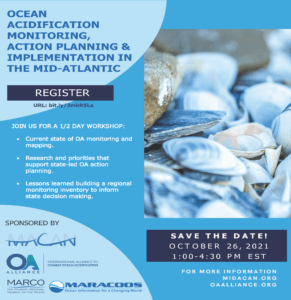
Supporting OA Action Planning and Implementation in the Mid-Atlantic
Mid Atlantic Coastal Acidification Network (MACAN) and OA Alliance Virtual Workshop
October 26
1:00 PM – 4:30 PM EST
(3.5 hours in duration)
The majority of the Mid-Atlantic coastal states are pursuing OA Action Planning either as stand-alone efforts or as part of broader coastal/ocean planning efforts. This workshop seeks to connect researchers, state agencies, and/or representatives from state legislatures from across the Mid-Atlantic region to help inform OA Action planning with an emphasis on identifying associated data/ information needs for management and coordinating monitoring where appropriate.
AGENDA
REGISTER
https://bit.ly/3mkR5Le
The Delaware Department of Natural Resources and Environmental Control (DNREC) contracted with Industrial Economics, Incorporated (IEc) and the RPS Group to model possible oil spill scenarios off the Delaware coast and the resulting economic impacts.
In partnership with the Mid-Atlantic Regional Council on the Ocean (MARCO) DNREC is hosting two webinars, March 24 and March 31. that will provide attendees a high-level overview of the report results and an opportunity to ask questions of the IEc and RPS staff who completed the work.
Although the results are Delaware specific DNREC and MARCO are hopeful that the results and processes used in the analysis can be used to support other states in the Mid-Atlantic to conduct their own analyses.
Integrated Oil Spill and Transport Modeling
Thursday, March 24, 2022
11 a.m. to 12 p.m.
The Delaware Department of Natural Resources and Environmental Control (DNREC) contracted with Industrial Economics, Incorporated (IEc) and the RPS Group to model possible oil spill scenarios off the Delaware coast and the resulting economic impacts.
In partnership with the Mid-Atlantic Regional Council on the Ocean (MARCO) DNREC is hosting two webinars, March 24 and March 31. that will provide attendees a high-level overview of the report results and an opportunity to ask questions of the IEc and RPS staff who completed the work.
Although the results are Delaware specific DNREC and MARCO are hopeful that the results and processes used in the analysis can be used to support other states in the Mid-Atlantic to conduct their own analyses.
Economic Impacts from an Offshore Oil Spill
Thursday, March 31, 2022
11 a.m. to 12 p.m.
To Register: https://attendee.got