This meeting will be conducted by webinar and has been shortened to April 7-8. Updated information is available at http://www.mafmc.org/briefing/
The Mid-Atlantic Ocean Data Portal recently published its first series of map layers showing typical sea surface current patterns for each season in Mid-Atlantic and southern New England waters. The maps are the latest data products developed through a partnership between the Mid-Atlantic Regional Association Coastal Ocean Observing System (MARACOOS), the Mid-Atlantic Regional Council on the Ocean (MARCO) and the MARCO Portal Team. In 2019, MARCO, the Portal Team and MARACOOS created a series of maps depicting average monthly sea surface temperatures based on 15 years of data. The groups continue to work together to develop map products for the Portal that draw upon the real-time observational data and expertise provided through MARACOOS.
You can learn more about the sea surface currents and temperatures maps in a special edition of our “How Tuesday” webinar series on April 14 from 11 a.m. to noon. Michael Crowley, technical director of MARACOOS and the Rutgers University Center for Ocean Observing Leadership, will discuss and demonstrate the maps on the Portal and the data products on the MARACOOS OceansMap that were used to create them.
Webinar URL: https://monmouth.adobeconnect.com/maracoos/
The webinar is free and open to the public. For planning purposes, please register in advance to Karl Vilacoba at kvilacob@monmouth.edu.
The dated for this event have been changed to November 16 – 17, 2020. Please go to that date on the MARCO calendar for registration information.
The New York Energy Research and Development Authority is hosting its second State of the Science Workshop on Offshore Wind Energy on May 5-6, 2020.
The two-day workshop will focus on assessing the state of the knowledge regarding offshore wind development’s cumulative effects on populations and ecosystems and identify key studies that could be conducted in the next 3-5 years to improve our understanding of cumulative biological impacts as the offshore wind industry develops in the U.S.
- The first day of the workshop will consist of plenary presentations on frameworks for understanding cumulative impacts as well as the current state of knowledge for different taxonomic groups.
- The second day will largely consist of smaller workshops focused on developing research plans to improve our understanding of cumulative impacts for a range of taxonomic groups, including benthos, fishes and mobile invertebrates, birds, bats, marine mammals, sea turtles, and habitats and ecosystems. Participation in breakout groups will require prior approval from workshop leads.
A poster session will be held on the evening of May 5, where workshop attendees will have an opportunity to share their work relating to wildlife and offshore wind (posters do not have to focus on cumulative impacts). A call for poster abstracts will be issued in early 2020.
There is also an opportunity to co-locate additional related meetings at the venue on May 7. If interested in planning a meeting or reserving room space, please contact julia.gulka@briloon.org.
State of the Science Workshops bring together stakeholders engaged with environmental and wildlife research relevant to offshore wind energy development in the eastern U.S. These workshops promote regional coordination and collaboration, and serve as a forum to share information on efforts to understand, minimize, and mitigate environmental impacts from offshore wind energy development. Workshops bring together scientists to present and discuss their research, but are open to members of the public with prior registration.
To request to be added to the workshop mailing list, please visit nyetwg.com.
For more information about the workshop, please contact conference organizers Kate Williams and Julia Gulka (Kate.Williams@briloon.org, Julia.Gulka@briloon.org).
Protecting biodiversity and building a sustainable global economy that protects nature is critical to people’s health and well-being. With its accessible virtual format, Capitol Hill Ocean Week 2020 is the opportunity for people from across the U.S. and the globe to engage in dialogue on actions we can take to conserve the variety of life on Earth for the long term health of our communities and the planet.
https://marinesanctuary.org/event/capitol-hill-ocean-week-2020/#schedule
Join us for a three part series exploring life in the deep sea. Pre-eminent scientists from around the Mid-Atlantic region will guide us on a tour of unique and exciting species living in extreme conditions far below the surface. We will explore the animals that live there and how they use both natural and man-made habitats to aid in their survival. From crustaceans and corals to sharks and whales, this is one webinar series you won’t want to miss!
Featured Speakers:
Canyon Landscapes and Species Interactions
- Dr. Peter Auster, Research Professor Emeritus of Marine Sciences, University of Connecticut and Senior Research Scientist, Mystic Aquarium
Canyons, Chondrichthyans and Conservation
- Merry Camhi, Director, New York Seascape, Wildlife Conservation Society, New York Aquarium
REGISTER
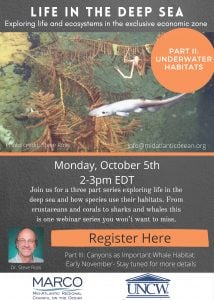
Join us for a three part series exploring life in the deep sea. Pre-eminent scientists from around the Mid-Atlantic region will guide us on a tour of unique and exciting species living in extreme conditions far below the surface. We will explore the animals that live there and how they use both natural and man-made habitats to aid in their survival. From crustaceans and corals to sharks and whales, this is one webinar series you won’t want to miss!
Featured Speaker: Steve Ross, Research Professor, Center for Marine Science, University of North Carolina – Wilmington
REGISTER
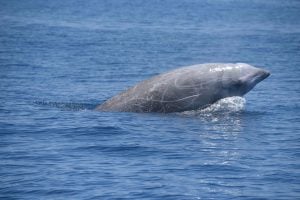
Join us for the third in a three part series exploring life in the deep-sea. A collection of scientists from the Mid-Atlantic will cover unique and exciting species living in both natural and man made habitats such as submarine canyons, methane seeps and shipwrecks. We will explore the animals that live there and how they use their habitats. From crustaceans and corals to sharks and whales this is one webinar series you won’t want to miss.
The New York State Energy Research and Development Authority (NYSERDA) is hosting its second State of the Science Workshop on Offshore Wind Energy on November 16-20, 2020.
The 2020 State of the Science Workshop is being held virtually this year in response to COVID-19. Workshop efforts remain focused on (1) assessing the state of the knowledge regarding offshore wind development’s cumulative effects on populations and ecosystems, and (2) working to identify key studies that could be conducted in the next 3-5 years to improve our understanding of cumulative biological impacts as the offshore wind industry develops in the U.S.
Plenary presentations and Q&A panel discussions will occur via an online event platform throughout the week of November 16-20. Smaller working meetings will be held virtually in late 2020 and early 2021, and efforts will culminate in a final webinar in the Spring of 2021 to report the outcomes of the breakout group efforts.
The Whova event platform has both a web version and mobile app that allows for easy access to the agenda, live-streamed sessions, community boards and more. Workshop registrants will need to create an account in Whova to access workshop sessions. More information can be found on the Workshop Logistics page.
For more information: