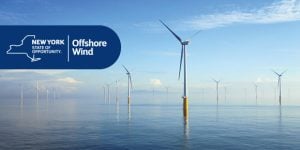
BOEM is hosting a Virtual New York Bight Intergovernmental Renewable Energy Task Force meeting on April 14 and 16, 2021, which will include an update on BOEM’s renewable energy planning activities and an opportunity for the public to provide input on a draft Proposed Sale Notice for the New York Bight.
For more information and to register for the Task Force Meeting, visit the New York Bight Task Force Virtual Meeting Room. Times will be announced soon.
Sincerely,
NYSERDA Offshore Wind Team
Monday, May 3, 2021 12:30 – 4:00 PM
Tuesday, May 4, 2021 9:30 AM – 3:00 PM
Wednesday, May 5, 2021 9:15 AM – 1:45 PM
Thursday, May 6, 2021 9:30 AM – 12:30 PM
For more information please visit the Forum web page.
Are you a newcomer interested in a Portal 101 session or a returning user who could use a refresher course? Then this webinar is for you!
Join us Tuesday, June 29, from 11 a.m. to noon for a #HowTu lesson on our data, tools and features. Come with your list of questions and learn how to map the Mid-Atlantic in this interactive session.
This webinar is free and open to the public. The lesson will be provided via Zoom by Portal team member Karl Vilacoba of Monmouth University’s Urban Coast Institute. To register, please click here.
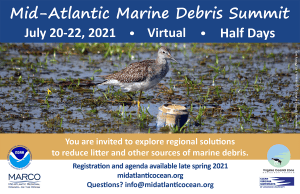
Marine debris is a growing global problem with wide-ranging impacts. Although much remarkable work to prevent and remove marine debris has been done, marine debris, particularly plastics, continues to accumulate in our ocean. This poses problems, often with deadly consequences, for marine wildlife as well as impacts to navigation, possibly our human health and our coastal economies.
Please join us on July 20-22 for a virtual Mid-Atlantic Marine Debris Regional Summit. Each of the three half day sessions will inspire collaboration and empower partners to work on solutions to marine debris. Attendees will represent state and federal agencies, tribes, NGOs, academia, and other groups tackling marine debris in the five Mid-Atlantic coastal states (New York, New Jersey, Delaware, Maryland, and Virginia) and Washington, DC. The public also is encouraged to participate.

On the East Coast of the United States, some species of fish are already experiencing climate-related shifts in distribution, abundance, and productivity. Although the future is uncertain, a continuation or acceleration of climate change has the potential to strain our existing fishery management system and alter the way fishermen, scientists, and the public interact with the marine environment.
In order to begin preparing for this possibility, management bodies along the entire Atlantic seaboard have teamed up to launch a new project called East Coast Climate Change Scenario Planning. Scenario planning is a way of exploring how fishery management may need to evolve over the next few decades in response to climate change. You can find additional details in the introductory brochure.
Weigh In! Stakeholder Input is Key to Effective Scenario Planning
The initiative is being organized by a Core Team of representatives from the New England, Mid-Atlantic, and South Atlantic Fishery Management Councils, the Atlantic States Marine Fisheries Commission, and NOAA Fisheries. The team has lined up three kick-off webinars:
Monday, August 30, 4:00 – 5:30 p.m.
Wednesday, September 1, 6:00 – 7:30 p.m.
Thursday, September 2, 10:00 – 11:30 a.m.
Please register at the links above. The webinars will introduce stakeholders to the overall initiative, explain the benefits of participating in the process, outline additional ways to become involved, and begin collecting stakeholder input.
On the East Coast of the United States, some species of fish are already experiencing climate-related shifts in distribution, abundance, and productivity. Although the future is uncertain, a continuation or acceleration of climate change has the potential to strain our existing fishery management system and alter the way fishermen, scientists, and the public interact with the marine environment.
In order to begin preparing for this possibility, management bodies along the entire Atlantic seaboard have teamed up to launch a new project called East Coast Climate Change Scenario Planning. Scenario planning is a way of exploring how fishery management may need to evolve over the next few decades in response to climate change. You can find additional details in the introductory brochure.
Weigh In! Stakeholder Input is Key to Effective Scenario Planning
The initiative is being organized by a Core Team of representatives from the New England, Mid-Atlantic, and South Atlantic Fishery Management Councils, the Atlantic States Marine Fisheries Commission, and NOAA Fisheries. The team has lined up three kick-off webinars:
Monday, August 30, 4:00 – 5:30 p.m.
Wednesday, September 1, 6:00 – 7:30 p.m.
Thursday, September 2, 10:00 – 11:30 a.m.
Please register at the links above. The webinars will introduce stakeholders to the overall initiative, explain the benefits of participating in the process, outline additional ways to become involved, and begin collecting stakeholder input.
On the East Coast of the United States, some species of fish are already experiencing climate-related shifts in distribution, abundance, and productivity. Although the future is uncertain, a continuation or acceleration of climate change has the potential to strain our existing fishery management system and alter the way fishermen, scientists, and the public interact with the marine environment.
In order to begin preparing for this possibility, management bodies along the entire Atlantic seaboard have teamed up to launch a new project called East Coast Climate Change Scenario Planning. Scenario planning is a way of exploring how fishery management may need to evolve over the next few decades in response to climate change. You can find additional details in the introductory brochure.
Weigh In! Stakeholder Input is Key to Effective Scenario Planning
The initiative is being organized by a Core Team of representatives from the New England, Mid-Atlantic, and South Atlantic Fishery Management Councils, the Atlantic States Marine Fisheries Commission, and NOAA Fisheries. The team has lined up three kick-off webinars:
Monday, August 30, 4:00 – 5:30 p.m.
Wednesday, September 1, 6:00 – 7:30 p.m.
Thursday, September 2, 10:00 – 11:30 a.m.
Please register at the links above. The webinars will introduce stakeholders to the overall initiative, explain the benefits of participating in the process, outline additional ways to become involved, and begin collecting stakeholder input.
Members of the public are invited to join a Port Access Route Studies Update & Map Data webinar on Sept. 14, at 10 a.m. In this special edition of the Mid-Atlantic Ocean Data Portal’s “How Tuesday” webinar series, presented in partnership with the Coast Guard and Northeast Regional Ocean Council, Coast Guard personnel will present information on findings, public comment opportunities and next steps for two draft reports for Port Access Route Studies focused on the approaches to the Chesapeake Bay in Virginia (CHESPARS) and the Northern New York Bight (NNYBPARS). In addition, demonstrations will be provided for publicly available tools and map data that can be used to explore the studies and their proposed routing measures in further depth.

The next meeting of the Responsible Offshore Science Alliance Advisory Council, which will be open to the public, will take place on September 24th from 1-4 pm EST. The meeting summary and presentations from the June 17th meeting can be found on the Advisory Council page of the website, and the agenda for the September meeting will be posted on this page a few weeks before the meeting.
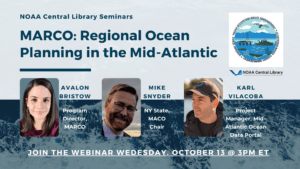
Join us for another NMFS Ecosystem Based Management/Ecosystem Based Fishery Management Seminar Series (EBM/EBFM)!
Presenters: Avalon Bristow, Program Director, MARCO; Mike Snyder, New York State Department of State, Steering Comm. Chair of Mid-Atlantic Committee on the Ocean; Karl Vilacoba, Urban Coast Institute’s Communications Director & Communications Lead/Project Manager for the Mid-Atlantic Ocean Data Portal
Abstract: The Mid-Atlantic Regional Council on the Ocean (MARCO) is the Regional Ocean Partnership for the Mid-Atlantic. MARCO has been coordinating across geographies and agencies around shared ocean priorities since 2009 when it was established by the governors of the five coastal Mid-Atlantic states – VA, MD, DE, NJ, and NY. In 2018, MARCO established the Mid-Atlantic Committee on the Ocean (MACO) to foster collaboration among states, federal agencies, the Mid-Atlantic Fishery Management Council (MAFMC), and federally recognized tribes, and to engage stakeholders. We will provide an update about ocean planning activities in the Mid-Atlantic, with a special focus on the region’s five topic-specific working groups and the Mid-Atlantic Ocean Data Portal.
About the Speakers
Avalon Bristow is Program Director at MARCO, where she works closely with the Board to develop and implement actions that advance MARCO’s priorities. She is staff support to MARCO’s collaborative work groups, is Co-Coordinator of the Mid-Atlantic Coastal Acidification Network in partnership with MARACOOS, and is Coordinator for the Regional Wildlife Science Entity in partnership with the Northeast Regional Ocean Council. Prior to joining MARCO, Avalon worked as a Program Manager for National Wildlife Federation’s Mid-Atlantic office, where she coordinated their coastal resilience and conservation education programs.
Mike Snyder is the Ocean and Great Lakes Program Manager at the New York State Department of State. He is currently a MARCO Management Board member and the Steering Committee Chair for the Mid-Atlantic Committee on the Ocean (MACO). Since joining the Department in 2008, Mike has been actively involved in advancing New York’s Ocean and Great Lakes policy agenda, including contributing to regulatory reviews of energy projects in the Offshore Atlantic, helping to create the Five-State Mid Atlantic Regional Council on the Ocean (MARCO), and coordinating State agency participation in the BOEM-New York Offshore Renewable Energy Task Force.
Karl Vilacoba is the Urban Coast Institute’s Communications Director and the communications lead/project manager for the Mid-Atlantic Ocean Data Portal. Prior to joining the UCI, Karl worked for the North Jersey Transportation Planning Authority, where he oversaw a variety of public outreach efforts and served as managing editor of InTransition, a national transportation magazine published in partnership with the New Jersey Institute of Technology. Karl previously spent a decade as a news reporter and editor for newspapers in the Jersey Shore area and at USA Today’s Manhattan Bureau. A lifelong Shore resident, Karl also served for several years as a member of the Lake Como Unified Planning & Zoning Board and the borough’s Environmental Commission.
POC: Peg Brady (peg.brady@noaa.gov); Library Seminars (library.seminars@noaa.gov)
Registration: https://register.gotowebinar.com/register/4462794963967362828