Over the past year, East Coast fishery management bodies have been collaborating on a climate change scenario planning initiative designed to prepare fishing communities and fishery managers for an era of climate change. The goals of this project are to assess how climate change might affect stock distribution and availability of East Coast marine fisheries over the next 20 years and to identify the implications for fishery management and governance.
In June 2022, a group of about 70 stakeholders attended a workshop to develop an initial set of scenarios, describing several different possible futures facing East Coast fisheries out to 2042. As the next step in the scenario planning process, two Scenario Deepening webinars will be held in August 2022. These webinars will offer all interested stakeholders an opportunity to review, validate, and add details to the draft scenarios.
Webinar Details
Each 2-hour session will begin with an overview of the outputs and stories from the draft scenarios. Participants will then have an opportunity to add comments and suggestions to make the scenarios more plausible, challenging, relevant, memorable, and divergent. For each scenario, participants will be encouraged to imagine specific examples about impacts to particular species, regions, and communities. Participants only need to attend one of the two webinars. Please use the links below to register:
- Wednesday, August 17, 2022, 3:00 p.m. – 5:00 p.m.
- Tuesday, August 23, 2022, 10:00 a.m. – 12:00 p.m.
The scenario creation workshop summary, including a description of the draft scenarios, is being developed and will be posted here once available. Participants are encouraged to review this summary before the webinars and come prepared to share comments on the specific scenarios.
Once again, stakeholder involvement is key, and these webinars are open to the public. The outcome of the two webinars will be a more detailed set of scenarios that will be used as a platform for later stages of the process, looking specifically at how fishery management and governance must change to be prepared for a future of climate change.
Learn More
Additional information is available on the Climate Change Scenario Planning Web Page and in the Introductory brochure.
Contact
If you have any questions, please contact a core team member.

Early bird registration rates end on Wednesday, July 6, 2022 at 11:59PM EST
For registration help, please contact spokane-registration-help@fisheries.org
Over the past year, East Coast fishery management bodies have been collaborating on a climate change scenario planning initiative designed to prepare fishing communities and fishery managers for an era of climate change. The goals of this project are to assess how climate change might affect stock distribution and availability of East Coast marine fisheries over the next 20 years and to identify the implications for fishery management and governance.
In June 2022, a group of about 70 stakeholders attended a workshop to develop an initial set of scenarios, describing several different possible futures facing East Coast fisheries out to 2042. As the next step in the scenario planning process, two Scenario Deepening webinars will be held in August 2022. These webinars will offer all interested stakeholders an opportunity to review, validate, and add details to the draft scenarios.
Webinar Details
Each 2-hour session will begin with an overview of the outputs and stories from the draft scenarios. Participants will then have an opportunity to add comments and suggestions to make the scenarios more plausible, challenging, relevant, memorable, and divergent. For each scenario, participants will be encouraged to imagine specific examples about impacts to particular species, regions, and communities. Participants only need to attend one of the two webinars. Please use the links below to register:
- Wednesday, August 17, 2022, 3:00 p.m. – 5:00 p.m.
- Tuesday, August 23, 2022, 10:00 a.m. – 12:00 p.m.
The scenario creation workshop summary, including a description of the draft scenarios, is being developed and will be posted here once available. Participants are encouraged to review this summary before the webinars and come prepared to share comments on the specific scenarios.
Once again, stakeholder involvement is key, and these webinars are open to the public. The outcome of the two webinars will be a more detailed set of scenarios that will be used as a platform for later stages of the process, looking specifically at how fishery management and governance must change to be prepared for a future of climate change.
Learn More
Additional information is available on the Climate Change Scenario Planning Web Page and in the Introductory brochure.
Contact
If you have any questions, please contact a core team member.
2022 Virginia Marine Debris Summit
September 27 & 28, 2022
Virginia Aquarium & Marine Science Center
SOLD OUT. Registration has closed.
To learn about Actions that can be taken to reduce litter and marine debris, visit the 2021-2025 Virginia Marine Debris Reduction Plan.
|
The 2022 Virginia Marine Debris Summit will be held in person at the Virginia Aquarium in Virginia Beach on September 27 and 28, 2022. Registration is closed. |
 |
The Summit is hosted and co-sponsored by:
- Virginia Coastal Zone Management Program
- Clean Virginia Waterways of Longwood University
- Virginia Aquarium & Marine Science Center
FOCUS: Since the majority of marine debris (about 80%) comes from inland sources, the entire summit will focus on preventing consumer debris (bottles, food wrappers, cigarette butts, bags, balloons and the other common and harmful sources of litter & debris).
SUPPORTERS: Funding to support the Summit is from the National Oceanic and Atmospheric Administration, Office of Coastal Management and the Freeman Family Fund. To become a supporter, contact Clean Virginia Waterways at cleanva@longwood.edu or use this link to make a donation. All support is greatly appreciated, and goes right into fighting litter and marine debris.
The Mid-Atlantic Fishery Management Council will meet Tuesday, October 4, 2022 – Thursday, October 6, 2022 at the Hyatt Place Dewey Beach (1301 Coastal Highway, Dewey Beach, DE 19971, 302-864-9100). This will be conducted as a hybrid meeting, with in-person and virtual participation options.
Webinar Information
The webinar will be conducted on the Webex meeting platform. No pre-registration is required.
-
The webinar link will be posted here at least two weeks prior to the meeting.
LIVE STREAM: For listen-only access, check out the Council meeting live stream on YouTube.
Public Comments
Comments may be submitted using the online comment form linked below or by email to cmoore@mafmc.org. Comments received by 5:00 p.m. on Wednesday, September 21, 2022 will be included in the relevant briefing tab. Comments submitted after this deadline and before 11:59 p.m. on Thursday, September 29, 2022 will be posted as supplemental materials. After the supplemental comment deadline, comments may only be submitted via the online form below (no email).
Agenda and Briefing Materials
Briefing materials will be posted below as they become available.
Save the Date: Next Advisory Council Meeting to be held October 28
The next advisory council meeting, which is open to the public, will be held on October 28 from 12-2:30 pm EST. The agenda for the meeting will be posted in early October on the advisory council page of our website; a meeting summary from the June advisory council meeting can now be found on this same page. As you know, collaboration is at the heart of ROSA’s mission, and these advisory council meetings provide us with a great opportunity to discuss and work together on critical initiatives. I hope you are able to participate in this fall’s meeting.
|


The Mid-Atlantic Fishery Management Council will meet December 12-15, 2022 in Annapolis, Maryland. Portions of the meeting will be conducted jointly with the Atlantic States Marine Fisheries Commission’s Summer Flounder, Scup, and Black Sea Bass Management Board and Interstate Fishery Management Program Policy Board.
This will be conducted as a hybrid meeting. Council members, other meeting participants, and members of the public will have the option to participate in person at The Westin Annapolis or virtually via Webex webinar. Please see the December 2022 Council Meeting Page for webinar details, public comment deadlines, briefing materials (as they become available), and other updates.
A detailed agenda is available here. Below is an overview of the main topics to be covered each day.
Monday, December 12
- Executive Committee (Closed Session)
- Habitat Activities Update
- Offshore Wind Updates
- Atlantic Surfclam and Ocean Quahog Species Separation Requirements Amendment – Final Action
Tuesday, December 13
(Joint with ASMFC boards)
- Harvest Control Rule Framework / Addendum Percent Change Approach and Recreational Fishery Models
- 2023 Scup Recreational Measures
- 2023 Black Sea Bass Recreational Measures
- 2023 Summer Flounder Recreational Measures
- Previously Initiated Recreational Reform Actions
Wednesday, December 14
- Climate Change Scenario Planning
- Monkfish Framework 13: 2023-2025 Specifications and Management Measures
- Protected Resources Updates
- 2023 Implementation Plan
Thursday, December 15
- Proposed Hudson Canyon National Marine Sanctuary
- Business Session
Questions? Contact Mary Sabo, msabo@mafmc.org, (302) 526-5261.
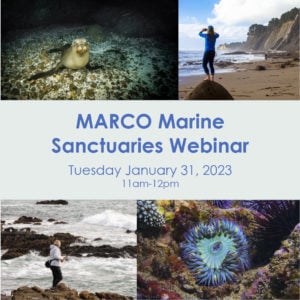
MARCO will hold a webinar on January 31 from 11:00 AM -12:00 PM entitled Marine Sanctuaries as a Mid-Atlantic Ocean Conservation Tool.
During this publicly available and free webinar, participants will learn about the designation of Stellwagen Bank National Marine Sanctuary and innovative approaches for accommodating various uses, including fishing, for the primary purpose of protecting natural and cultural resources. We will then hear how Mid-Atlantic Ocean Data Portal can be used to visualize use of ocean and coastal space This webinar is particularly timely given the ongoing designation process of a national marine sanctuary at Hudson Canyon.
Please register for the webinar at https://zoom.us/meeting/register/tJMpceCrrzIvH9Pg2kbzSrFJxLAbSM8C7Fdl
Agenda
- Introductions and Opening Remarks, Kevin Hassell, Environmental Specialist, New Jersey Department of Environmental Protection Coastal Management Program
- Accommodating Multiple Uses: A Case Study from Stellwagen Bank National Marine Sanctuary: Ben Haskell, Deputy Superintendent
- Exploring the Hudson Canyon with the Mid-Atlantic Ocean Data Portal: Karl Vilacoba, Communications Director, Urban Coast Institute at Monmouth University
- Q&A
- Examining impacts of extreme discharge events and climate change on the carbonate system of the York River Estuary using a coupled physical-biogeochemical model
- Comparing climate resilience of selectively-bred larval aquaculture broodstock to that of the wild Eastern oyster, Crassostrea virginica
- Building collaborative partnerships between scientists and educators to develop new education materials focused on the effects of ocean acidification on American lobsters
Abstracts and Speaker Information:
Wild-n-wacky or Bred-n-butter: Are Larvae from Selectively-bred Aquaculture Broodstock More Resilient to Climate Change than those from Wild Eastern Oysters,Crassostrea virginica?
Eastern oysters (Crassostrea virginica) provide ecosystem (e.g. 3-D reef structures) and economic (e.g. aquaculture) services to the Chesapeake Bay and other coastal areas. Oyster aquaculture is a growing industry, and the need for traits such as fast growth and disease resistance led to the development of multiple generations of selectively-bred and refined broodstock lines. Development and preservation of selected broodstock could affect various physiological processes in offspring that could potentially result in different responses to stress compared to their wild counterparts. As environmental conditions within the Chesapeake Bay continue to shift warmer and more acidic – which are individually and simultaneously known to decrease shell and tissue growth, decrease energy stores, change metabolic pathways and affect development – responses to these conditions may differ between selectively-bred and wild oysters, potentially affecting their success in the future. Because larval oysters are considered the most vulnerable and sensitive life stage and therefore are already a bottleneck to the success of wild oyster populations and aquaculture production, my study exposed larvae from wild oysters and selectively-bred broodstock to four treatments composed of two temperature and two acidic conditions that represent average ambient and current extreme states in the mesohaline region of the Chesapeake Bay. Growth, biomass, cellular stress, and survival were measured throughout showing that larvae from wild oysters may be more resilient to warming and acidifying waters than those from selectively-bred oysters.
Annie Schatz, Ph.D candidate at the Virginia Institute of Marine Science, William & Mary. She works with Dr. Emily Rivest to study the potential physiological impacts of climate change on the early-life stages of marine invertebrate species. Her research focuses on effects from multiple environmental stressors, ocean acidification, how environmental history may impact performance of later life stages and shellfish aquaculture. Annie received her B.S. from Pitzer College in Claremont, CA where she studied how the respiration rates of two populations of Acorn barnacles differed across a range of temperatures.
Building collaborative relationships between scientists and educators is an important step in improving climate change education. By providing real-world data and hands-on experiences, scientists can assist students in connecting marine processes with changes in marine and human communities. A recent project focused on understanding effects of ocean acidification on American lobsters is a strong case study for extended collaboration between scientists and educators. Three main tools were used to develop educational materials: an internship to provide hands-on research experience for science teachers, multimedia content for sharing information about the project, and the Virginia Scientist Educator Alliance (VASEA) to provide training for lesson plan design. Together, these project components can serve as a roadmap for scientists and educators looking to improve ocean acidification education.
Abbey Sisti, PhD candidate at the Virginia Institute of Marine Science. She has a B.S. and M.S. in Biological Sciences from the University of Alabama. Her research focuses on understanding marine invertebrate responses to climate change conditions. Abbey is interested in translating climate change science to educational and policy contexts.