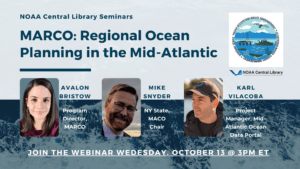
Join us for another NMFS Ecosystem Based Management/Ecosystem Based Fishery Management Seminar Series (EBM/EBFM)!
Presenters: Avalon Bristow, Program Director, MARCO; Mike Snyder, New York State Department of State, Steering Comm. Chair of Mid-Atlantic Committee on the Ocean; Karl Vilacoba, Urban Coast Institute’s Communications Director & Communications Lead/Project Manager for the Mid-Atlantic Ocean Data Portal
Abstract: The Mid-Atlantic Regional Council on the Ocean (MARCO) is the Regional Ocean Partnership for the Mid-Atlantic. MARCO has been coordinating across geographies and agencies around shared ocean priorities since 2009 when it was established by the governors of the five coastal Mid-Atlantic states – VA, MD, DE, NJ, and NY. In 2018, MARCO established the Mid-Atlantic Committee on the Ocean (MACO) to foster collaboration among states, federal agencies, the Mid-Atlantic Fishery Management Council (MAFMC), and federally recognized tribes, and to engage stakeholders. We will provide an update about ocean planning activities in the Mid-Atlantic, with a special focus on the region’s five topic-specific working groups and the Mid-Atlantic Ocean Data Portal.
About the Speakers
Avalon Bristow is Program Director at MARCO, where she works closely with the Board to develop and implement actions that advance MARCO’s priorities. She is staff support to MARCO’s collaborative work groups, is Co-Coordinator of the Mid-Atlantic Coastal Acidification Network in partnership with MARACOOS, and is Coordinator for the Regional Wildlife Science Entity in partnership with the Northeast Regional Ocean Council. Prior to joining MARCO, Avalon worked as a Program Manager for National Wildlife Federation’s Mid-Atlantic office, where she coordinated their coastal resilience and conservation education programs.
Mike Snyder is the Ocean and Great Lakes Program Manager at the New York State Department of State. He is currently a MARCO Management Board member and the Steering Committee Chair for the Mid-Atlantic Committee on the Ocean (MACO). Since joining the Department in 2008, Mike has been actively involved in advancing New York’s Ocean and Great Lakes policy agenda, including contributing to regulatory reviews of energy projects in the Offshore Atlantic, helping to create the Five-State Mid Atlantic Regional Council on the Ocean (MARCO), and coordinating State agency participation in the BOEM-New York Offshore Renewable Energy Task Force.
Karl Vilacoba is the Urban Coast Institute’s Communications Director and the communications lead/project manager for the Mid-Atlantic Ocean Data Portal. Prior to joining the UCI, Karl worked for the North Jersey Transportation Planning Authority, where he oversaw a variety of public outreach efforts and served as managing editor of InTransition, a national transportation magazine published in partnership with the New Jersey Institute of Technology. Karl previously spent a decade as a news reporter and editor for newspapers in the Jersey Shore area and at USA Today’s Manhattan Bureau. A lifelong Shore resident, Karl also served for several years as a member of the Lake Como Unified Planning & Zoning Board and the borough’s Environmental Commission.
POC: Peg Brady (peg.brady@noaa.gov); Library Seminars (library.seminars@noaa.gov)
Registration: https://register.gotowebinar.com/register/4462794963967362828
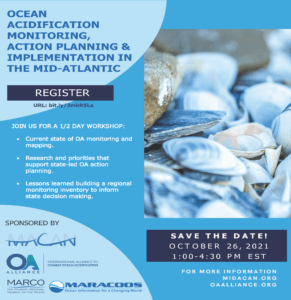
Supporting OA Action Planning and Implementation in the Mid-Atlantic
Mid Atlantic Coastal Acidification Network (MACAN) and OA Alliance Virtual Workshop
October 26
1:00 PM – 4:30 PM EST
(3.5 hours in duration)
The majority of the Mid-Atlantic coastal states are pursuing OA Action Planning either as stand-alone efforts or as part of broader coastal/ocean planning efforts. This workshop seeks to connect researchers, state agencies, and/or representatives from state legislatures from across the Mid-Atlantic region to help inform OA Action planning with an emphasis on identifying associated data/ information needs for management and coordinating monitoring where appropriate.
AGENDA
REGISTER
https://bit.ly/3mkR5Le
Join us Nov. 16 at 2 p.m. for an edition of the Portal’s “How Tuesday” webinar series that provides a tutorial on using Groups and the Portal’s other advanced tools.
Topics to be covered include:
- Editing the appearance of maps in the Active tab
- How to create and save Drawings and Map Bookmarks
- How to start a Group and share Drawings and Map Bookmarks with members
- Overlaying map data from outside websites with the Portal’s ArcGIS Service Input Tool
- Additional Marine Planner buttons: Operating the linear measurement tool, generating short URLs and embed codes, and exporting PDF files of maps
- A peak ahead at tool upgrades planned for the future
Following the tutorial, attendees can ask Portal team members any questions they’d like in an open Q&A session. We would also love to hear your ideas on any tool additions or enhancements that could help make the Portal more useful for you.
The session will be hosted by Portal project manager Karl Vilacoba of the Monmouth University Urban Coast Institute and developer Ryan Hodges of Ecotrust. To register and obtain a Zoom link, please click here.
In person at the Westin Annapolis (100 Westgate Circle Annapolis, MD 21401) and online via Webex webinar.
This meeting will be conducted as a hybrid meeting. Council members, other meeting participants, and members of the public will have the option to participate in person at the Westin Annapolis or virtually via Webex webinar. Both virtual attendees and those attending the meeting in person will use the “raise hand” function in Webex to comment, ask questions, make motions, and vote. We are recommending that all in-person attendees either be vaccinated or receive a negative COVID test prior to meeting attendance. We are also encouraging attendees to wear a mask when moving around the hotel and meeting space.
Webinar Information
The virtual portion of the meeting will be conducted via Webex webinar. No pre-registration is required. The webinar link will be the same for all four meeting days.
-
Click here to join the webinar (if prompted, enter meeting number: 2330 933 4966; Meeting password: ncKMj56xX6p)
-
Join by phone: For those who will not be joining the webinar but would like to listen in to the audio portion only, dial 1-415-655-0001 and enter access code: 2330 933 4966#). When asked for your attendee ID, enter #. Participants connected by phone only will need to enter *6 on their keypad to unmute/mute themselves and *3 to raise/lower their hands.
-
Need Help? If you need technical assistance, please check the Webex Participant Guide. For further assistance, contact Mary Sabo at msabo@mafmc.org or 302-518-1143 (call or text).
We will also be live streaming the meeting to our YouTube channel.
The Council will meet February 8-10, 2022 in Durham, NC.
-
Meeting Venue: Durham Convention Center, 301 W. Morgan St, Durham, NC 27701
-
Sleeping Rooms: Marriott Durham Hotel, 201 Foster St, Durham, NC 27701
Additional details will be posted at a later date here.
Over the past year, East Coast fishery management bodies have been collaborating on a climate change scenario planning initiative designed to prepare fishing communities and fishery managers for an era of climate change. The goals of this project are to assess how climate change might affect stock distribution and availability of East Coast marine fisheries over the next 20 years and to identify the implications for fishery management and governance. The next step in the scenario planning process is the Exploration phase. Building on the input gathered during scoping, this phase will include a series of three webinars which will focus on identifying and analyzing the major drivers of change in greater depth.
Each of the three webinars will address a different category of forces driving change in East Coast fisheries (see schedule below for details). Participants are encouraged to attend all three webinars, if possible, to take in the full range of issues being explored. The webinars will contain a keynote address, a panel discussion, and a limited opportunity for comments, questions, and discussion. Three background documents are being developed with specific information to support each webinar. Once completed, these documents will be posted here. Participants are encouraged to review these backgrounders before the webinars begin and come prepared to share comments on the primary drivers of change for East Coast fisheries.
Webinar Schedule and Topics
Click on the webinar titles below to view webinar registration details. Note that it may take up to 24 hours after registering to receive a confirmation email for the webinar.
Webinar #1: Oceanographic Drivers of Change – February 14, 2022, 3:00 p.m. – 4:30 p.m.
This webinar will look in detail at the trends in oceanography that are poised to shape East Coast fisheries over the next 20 years, such as changing ocean temperature, acidification, sea level rise, ocean currents and other developments. How predictable are these trends, and what impact might they have?
Webinar #2: Biological Drivers of Change – February 23, 2022, 3:00 p.m. – 4:30 p.m.
This webinar will explore expected and possible biological trends, including changes in the geographic range, distribution, and productivity of stocks, as well as changes in habitat, predator/prey relationships, and other ecosystem dynamics. What are the prospects for how these factors might develop and interact over the next 20 years?
Webinar #3: Social and Economic Drivers of Change – March 2, 2022, 3:00 p.m. – 4:30 p.m.
This webinar will focus on social and economic trends that may affect fisheries, such as changing consumer demand and food production, other competing ocean uses (e.g., offshore energy and aquaculture), loss of working waterfronts, and other developments. How important will these developments be in shaping fisheries in the next 20 years?
Learn More
Additional information is available on the Climate Change Scenario Planning Web Page and in the Introductory brochure.
Over the past year, East Coast fishery management bodies have been collaborating on a climate change scenario planning initiative designed to prepare fishing communities and fishery managers for an era of climate change. The goals of this project are to assess how climate change might affect stock distribution and availability of East Coast marine fisheries over the next 20 years and to identify the implications for fishery management and governance. The next step in the scenario planning process is the Exploration phase. Building on the input gathered during scoping, this phase will include a series of three webinars which will focus on identifying and analyzing the major drivers of change in greater depth.
Each of the three webinars will address a different category of forces driving change in East Coast fisheries (see schedule below for details). Participants are encouraged to attend all three webinars, if possible, to take in the full range of issues being explored. The webinars will contain a keynote address, a panel discussion, and a limited opportunity for comments, questions, and discussion. Three background documents are being developed with specific information to support each webinar. Once completed, these documents will be posted here. Participants are encouraged to review these backgrounders before the webinars begin and come prepared to share comments on the primary drivers of change for East Coast fisheries.
Webinar Schedule and Topics
Click on the webinar titles below to view webinar registration details. Note that it may take up to 24 hours after registering to receive a confirmation email for the webinar.
Webinar #1: Oceanographic Drivers of Change – February 14, 2022, 3:00 p.m. – 4:30 p.m.
This webinar will look in detail at the trends in oceanography that are poised to shape East Coast fisheries over the next 20 years, such as changing ocean temperature, acidification, sea level rise, ocean currents and other developments. How predictable are these trends, and what impact might they have?
Webinar #2: Biological Drivers of Change – February 23, 2022, 3:00 p.m. – 4:30 p.m.
This webinar will explore expected and possible biological trends, including changes in the geographic range, distribution, and productivity of stocks, as well as changes in habitat, predator/prey relationships, and other ecosystem dynamics. What are the prospects for how these factors might develop and interact over the next 20 years?
Webinar #3: Social and Economic Drivers of Change – March 2, 2022, 3:00 p.m. – 4:30 p.m.
This webinar will focus on social and economic trends that may affect fisheries, such as changing consumer demand and food production, other competing ocean uses (e.g., offshore energy and aquaculture), loss of working waterfronts, and other developments. How important will these developments be in shaping fisheries in the next 20 years?
Learn More
Additional information is available on the Climate Change Scenario Planning Web Page and in the Introductory brochure.
Please join us February 28, 1pm-2pm for our first webinar of the season: “Creating a Coastal Acidification Module for Mid-Atlantic Teachers“. Sarah Nuss, Education Coordinator for the Chesapeake Bay NERR in Virginia, and Greta Olsen, NOAA Hollings Scholar, are excited to share work underway on this new educational resource for K-12 teachers.
To Register: https://attendee.gotowebinar.com/register/1132105970982526988
After you have registered, you’ll receive a confirmation email containing information about how to join the webinar.
Abstract: Teachers on the Estuary (TOTE) workshops are held at each National Estuarine Research Reserve site every year. In an effort to include habitat change and impacts to our local environment, TOTE educators look to include coastal acidification into the information provided to K-12 teachers at these workshops. Come and learn about a new coastal acidification module underway for the Mid-Atlantic, created by a regional network of educators, and pilot tested with teachers last summer. We’ll include the current phase of the module, as well as next steps in its development and testing.
Speaker Information:
Greta Olsen is a 2020-2022 NOAA Hollings Scholar. Through the Hollings program, she worked virtually as an education intern at the Chesapeake Bay National Estuarine Research Reserve (CBNERR) in Virginia this summer. During Greta’s time with the reserve, she designed and implemented an evaluation for a marine science camp, created a learning module on coastal acidification specific to the Mid-Atlantic region, and served as an instructor at the camp and workshop hosted by CBNERR. Greta is a senior at the University of Kansas and will graduate this spring with a B.S. in chemical engineering. After graduation, Greta will work as an environmental engineer at a Phillips 66 refinery.
Sarah Nuss is the Education Coordinator for the Chesapeake Bay National Estuarine Research Reserve in Virginia, located at the Virginia Institute of Marine Science (VIMS). An experienced environmental educator, Sarah has worked at VIMS for the past 16 years where she provides meaningful watershed educational experiences for students, builds capacity for future MWEEs by providing professional development opportunities for teachers, and coordinates an extensive summer camp program for the general public. Sarah is a Ph.D. candidate at the College of William & Mary, studying curriculum and learning design, specifically focused on environmental education. Sarah lives in Williamsburg, VA with her husband and twin daughters.
Over the past year, East Coast fishery management bodies have been collaborating on a climate change scenario planning initiative designed to prepare fishing communities and fishery managers for an era of climate change. The goals of this project are to assess how climate change might affect stock distribution and availability of East Coast marine fisheries over the next 20 years and to identify the implications for fishery management and governance. The next step in the scenario planning process is the Exploration phase. Building on the input gathered during scoping, this phase will include a series of three webinars which will focus on identifying and analyzing the major drivers of change in greater depth.
Each of the three webinars will address a different category of forces driving change in East Coast fisheries (see schedule below for details). Participants are encouraged to attend all three webinars, if possible, to take in the full range of issues being explored. The webinars will contain a keynote address, a panel discussion, and a limited opportunity for comments, questions, and discussion. Three background documents are being developed with specific information to support each webinar. Once completed, these documents will be posted here. Participants are encouraged to review these backgrounders before the webinars begin and come prepared to share comments on the primary drivers of change for East Coast fisheries.
Webinar Schedule and Topics
Click on the webinar titles below to view webinar registration details. Note that it may take up to 24 hours after registering to receive a confirmation email for the webinar.
Webinar #1: Oceanographic Drivers of Change – February 14, 2022, 3:00 p.m. – 4:30 p.m.
This webinar will look in detail at the trends in oceanography that are poised to shape East Coast fisheries over the next 20 years, such as changing ocean temperature, acidification, sea level rise, ocean currents and other developments. How predictable are these trends, and what impact might they have?
Webinar #2: Biological Drivers of Change – February 23, 2022, 3:00 p.m. – 4:30 p.m.
This webinar will explore expected and possible biological trends, including changes in the geographic range, distribution, and productivity of stocks, as well as changes in habitat, predator/prey relationships, and other ecosystem dynamics. What are the prospects for how these factors might develop and interact over the next 20 years?
Webinar #3: Social and Economic Drivers of Change – March 2, 2022, 3:00 p.m. – 4:30 p.m.
This webinar will focus on social and economic trends that may affect fisheries, such as changing consumer demand and food production, other competing ocean uses (e.g., offshore energy and aquaculture), loss of working waterfronts, and other developments. How important will these developments be in shaping fisheries in the next 20 years?
Learn More
Additional information is available on the Climate Change Scenario Planning Web Page and in the Introductory brochure.
Ocean acidification has subtle and complicated effects on fish because it often affects only the earliest life stages and interacts with other stressors. This project pulled together several types of data from multistressor experiments on Atlantic silversides, an abundant fish along the East Coast, to model their energy budget throughout the life cycle. Using Dynamic Energy Budget theory (DEB) we are able to incorporate different effects at each life stage to reflect the increased tolerance adults have relative to embryos and larvae. Energy budgets can help us test hypotheses about how energy is allocated to needs like homeostasis and reproduction under acidification, and ultimately estimate population-level effects.
Using Gene Silencing to Validate the Role of Perlucin Gene in Oyster Resilience to Ocean Acidification
Caroline Schwaner, Stony Brook University
We previously investigated the molecular mechanisms associated with resilience to ocean acidification in Crassostrea virginica. There were significant differences in SNP and gene expression profiles among oysters reared under normal and OA conditions. Both of these approaches showed similar results, particularly in genes related to biomineralization, including perlucin. In this study, we used RNAi or gene silencing to validate findings and confirm the protective role of perlucin associated with resilience to OA. Silenced oysters under acidification stress were the smallest, had shell abnormalities, and had significantly reduced shell mineralization, thereby indicating that perlucin does help larvae mitigate the effect of OA.
Impacts of extreme events on carbonate system variability in the York River Estuary: a numerical model study
Fei Da, Virginia Institute of Marine Science
Better understanding the carbonate system variability during extreme events will help predict future changes and provide critical information for the local shellfish aquaculture industry. In this study, a coupled hydrodynamic-biogeochemical 3-D high-resolution model is used to investigate the primary controls of the carbonate system in a small sub-estuary of the Chesapeake Bay: the York River Estuary. Net horizontal advection, air-sea CO2 flux, and net community production all play crucial roles in controlling dissolved inorganic carbon (DIC) and pH, while total alkalinity is relatively conservative. During extreme high discharge events, pH reductions are associated with net heterotrophy and net advection of high DIC upstream water, with increased outgassing playing a counteracting role.
Influence of water quality history on future ocean acidification tolerance in larval eastern oysters in Chesapeake Bay
Anthony Himes, Virginia Institute of Marine Science
One species of calcifying organisms that could be pushed beyond their physiological limits due to future acidification is the eastern oyster, C. virginica, which provides the basis for an expanding aquaculture industry. Previous studies have shown that oyster larvae are negatively impacted by acidification, but less is known about what level of acidification initiates a stress response and how well larvae can modulate these mechanisms. Additionally, little is known about potential differences in stress tolerance among different oyster populations. Therefore, larvae were compared between two different reefs within Chesapeake Bay to assess the hypothesis that reefs exposed to lower salinity conditions will be more tolerant to future acidification due to overlap in the cellular mechanisms responsible for osmoregulation and acid-base regulation.
Development and applications of pH glider technology in the Mid-Atlantic Bight
Liza Wright-Fairbanks, Sea Grant Knauss Fellow, NOAA OAP
Currently, productive coastal systems lack vertically-resolved high-resolution ocean carbonate system measurements on timescales relevant to organism ecology and life history. To address this issue, a newly developed deep ISFET (Ion Sensitive Field Effect Transistor)-based pH sensor system was modified and integrated into a Slocum G2 profiling glider. From Spring 2018 to Fall 2019, seasonal pH glider deployments were conducted in Atlantic surfclam (Spisula solidissima) and Atlantic sea scallop (Placopecten magellanicus) commercial management zones in the Mid-Atlantic Bight. Here, we present seasonal cycles and drivers of carbonate chemistry in the Mid-Atlantic Bight based on seasonal glider deployments. Additionally, we discuss the use of glider data in conjunction with larval dispersal models to identify times and locations where shellfish stock may be at high risk of acidification.