The Mid-Atlantic Fishery Management Council will meet by webinar Monday, December 14 – Thursday, December 17, 2020. Webinar connection details and briefing materials will be posted on this page as they become available.
Questions? Contact Mary Sabo – msabo@mafmc.org, 302-518-1143.
Public Comments
Public comments can be submitted using the online form linked below or by mail, email, or fax (see this page for addresses). Comments submitted by 11:59 p.m. on Wednesday, December 2, 2020 will be included in the briefing book. Comments submitted after this date but before 5:00 p.m. on December 10, 2020 will be posted as supplemental materials. After that date, comments may only be submitted using the form below.
Agenda
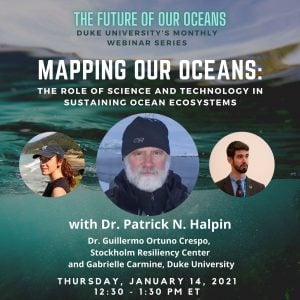
Despite covering 70% of the planet’s surface, we are only beginning to understand the seascapes, species, and processes of the world’s changing oceans. We are at a critical juncture in our knowledge of how ‘planet ocean’ will respond in the Anthropocene. To close this knowledge gap, new geospatial technologies are playing a crucial role in addressing many ocean challenges, including marine ecology, resource management, and ocean conservation. In this webinar, Duke University scientist Pat Halpin and his colleagues will describe the exciting developments in geospatial ocean science and technology, and how they are being used to support ocean health and sustainable use. These advances are also informing the development of new ocean governance structures, including the development of the new implementation agreement for the Law of the Sea as well as helping to set priorities for the coming UN Decade of Ocean Science for Sustainable Development.
Learn about the physical dimensions of marine cable installation, the environmental and marine use implications, best practices, and stakeholder considerations. Joel Whitman, Executive Vice President, Global Marine Group will provide an overview of the cable installation process. David Slee of Burns & McDonnell will highlight lessons learned from the EU experience. Speakers and panelists from the Northeast and Mid-Atlantic will then discuss issues and potential impacts to protected species, habitat, and fisheries in the region.
The Mid-Atlantic Fishery Management Council (Council) has two upcoming meetings in February. Both meetings will be conducted by webinar.
February 1, 2021 – ASMFC Winter 2021 Meeting
On Monday, February 1, 2021, the Council will meet jointly with the Atlantic States Marine Fisheries Commission’s (ASMFC) ISFMP Policy Board and Summer Flounder, Scup, and Black Sea Bass Management Board. This joint meeting will be held on the first day of the ASMFC’s Winter 2021 Meeting. During the meeting, the Council and Policy Board will receive an update on the Recreational Management Reform Initiative and discuss next steps. Then the Council and Summer Flounder, Scup, and Black Sea Bass Board will consider final action on the Black Sea Bass Commercial State Allocation Amendment/Draft Addendum XXXIII. Instructions and deadlines for submission of written comments are available on the ASMFC’s Winter 2021 meeting page. Webinar connection instructions will be available on the ASMFC meeting page by January 20. Materials for the joint portion of the meeting will also be posted on the Council’s February 1 Joint meeting page as they become available.
Johannes Pfeifenberger of The Brattle Group will share results from a recent analysis of the anticipated scale of offshore wind development needed to meet state public policy goals and the benefits of taking a systems approach to offshore wind transmission planning. Ben D’Antonio, Senior Counsel & Analyst, New England States Committee on Electricity (NESCOE) will highlight New England’s vision for a clean, affordable and reliable 21st century regional electric grid. Speakers and panelists from the Northeast and Mid-Atlantic will then discuss issues and potential impacts related to protected species, habitat, and fisheries in the region.
The Council will meet again via webinar on Wednesday, February 10 and Thursday, February 11, 2021. A portion of the meeting will be conducted jointly with the ASMFC’s Bluefish Management Board. During this meeting, the Council will receive presentations on North Atlantic right whale issues, aquaculture projects, and offshore wind updates. The Council will also review staff white papers on river herring and shad issues, and the Council and Bluefish Board will meet jointly to approve a joint public hearing document for the Bluefish Allocation and Rebuilding Amendment. An agenda and webinar connection details are available on the February 2021 Meeting Page. Briefing materials will be posted as they become available.
Questions? Contact Mary Sabo, msabo@mafmc.org, (302) 518-1143.
Learn about regulatory, operational and management characteristics of electricity transmission from offshore wind projects, and the challenges of shifting to a new planning paradigm offshore. Rob Gramlich of Grid Strategies, LLC will provide an overview of how the grid works. Mark Kalpin of Holland & Knight will address regulatory considerations for offshore wind transmission planning.
Other experts have been invited to speak about New Jersey’s recent announcement to align state offshore transmission policy with the grid operator’s planning process. Presentations will be followed by discussion and Q&A.
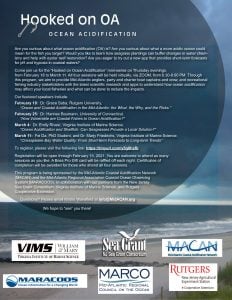
Come join us for the “Hooked on Ocean Acidification” mini-series on Thursday evenings,
from February 18 to March 11. All four sessions will be held virtually, via ZOOM, from 6:30-8:00 PM.
Through this program, we aim to provide Mid-Atlantic anglers, party and charter boat captains and crew, and recreational fishing industry stakeholders with the latest scientific research and apps to understand how ocean acidification may affect your local fisheries and what can be done to reduce the impacts.
Contact Kirstin Wakefield at info@MidACAN.org for more information.
To register, please visit the following link: https://tinyurl.com/y5g8hsfb
You are invited to attend the MACAN February webinar, “Climate Change and Submerged Cultural and Heritage Resources in the Mid-Atlantic,” on February 25, 2021 at 1:00PM EDT. Maryland’s State Underwater Archaeologist, Dr. Susan Langley, will discuss how climate change, including ocean acidification, impacts Mid-Atlantic cultural and heritage resources.
Although our maritime heritage is young compared to the Vikings’, our country has thousands of cultural resources such as shipwrecks, shell middens, and sunken vessels from WWII, that lie under or adjacent to the Mid-Atlantic’s coastal waters. This presentation examines how different aspects of climate change, including ocean acidification, impact our heritage resources. It defines the diverse cultural materials affected, and considers the potential and resulting effects on archaeological research, the environment, and the economy. In addition, means of addressing these effects, both active and proposed are discussed. One example involves a survey of archaeologists associated with government agencies, academic institutions, and non-profit organizations who all placed ocean acidification in the top three most damaging climate change threats they face in their work. This has led to increased networking at a global level as we enter the U.N. Decade of Ocean Science for Sustainable Development.
Please register at: https://attendee.gotowebinar.com/register/6145951551914346000
After registering, you will receive a confirmation email containing information about joining the webinar.