Protecting biodiversity and building a sustainable global economy that protects nature is critical to people’s health and well-being. With its accessible virtual format, Capitol Hill Ocean Week 2020 is the opportunity for people from across the U.S. and the globe to engage in dialogue on actions we can take to conserve the variety of life on Earth for the long term health of our communities and the planet.
https://marinesanctuary.org/event/capitol-hill-ocean-week-2020/#schedule
Mid-Atlantic Fish Habitat is Changing
Changes in the Northwest Atlantic Ocean shelf ecosystem will force ocean fish and invertebrate species to move. Fish are sensitive to water temperature, and as it becomes too warm, populations will shift to where the water temperature is optimal for them and their prey. This is occurring through multiple processes at different rates, with different species moving or recruiting into new areas. Along the Atlantic coast, generally, more species of fish will move northward and poleward, or further offshore into deeper cooler waters to where the temperature range is more habitable for them. Climate-driven shifts in marine fish species create cross-disciplinary and often contentious issues for resource managers and decision-makers. Ecosystem level changes will impact fisheries management, coastal communities and economies, as well as other regional ocean uses that contribute to the fabric of the coastal economy.
This session is intended to help Mid-Atlantic Committee on the Ocean (MACO) members and stakeholders better understand how research examining fish species and fish habitat shifts will contribute to the body of knowledge to help fishermen, fisheries managers, ocean use planners, and coastal communities track ocean change, assess fisheries resources at risk, and ultimately safeguard the nation’s valuable marine fish stocks in this dynamic and ever changing ocean space.
The session will include presentations from:
- Vincent S. Saba: NOAA National Marine Fisheries Service(NMFS)/Princeton University Geophysical Fluid Dynamics Laboratory
- Rich J. Bell: The Nature Conservancy
- Victoria Kentner and Chris Haak: Integrated Statistics/NOAA NMFS/Monmouth University
- Emily Farr, Mike Johnson, and Mark Nelson: NOAA NMFS
- James W. Morley, East Carolina University, Coastal Studies Institute
The panel of experts will then answer questions and share their thoughts on this pressing issue in our region.
Please register for this webinar. Registration is REQUIRED due to a maximum number of participants allowed by the webinar platform. A wait list will be kept in the event that capacity is reached.
Questions: info@legacy.midatlanticocean.org
MARCO and MACO events are made possible by the Gordon and Betty Moore Foundation.
Join us on June 16 at 2 p.m. for the latest installment of our “How Tuesday” webinar series dedicated to U.S. Coast Guard data recently published on the Portal. Two new maps show a Port Access Route Study (PARS) area extending offshore from Long Branch, New Jersey, to the Ocean City, Maryland, area, and a proposed anchorage area near the approach to the Cape Fear River in North Carolina. In this webinar, Jerry Barnes and Matt Creelman of the U.S. Coast Guard’s Fifth District will provide additional information on the study and anchorage area, demonstrate the new maps, and discuss how the Portal can be used to analyze the sites and inform public comments submitted via the Federal Register.
The webinar is free and open to the public. For planning purposes, please register in advance to Karl Vilacoba at kvilacob@monmouth.edu.
To provide another opportunity to those who were not able to join the Mid-Atlantic Ocean Forum webinar on May 19th, MACO will convene a second abbreviated Mid-Atlantic Ocean Forum webinar on Tuesday June 23 from 10 – 11:30 am.
This webinar is structured like the first webinar to provide engaging opportunities for you to provide your input on MACO activities, and “brainstorm” issues for further collaboration. The information from this webinar will be combined with the information from the May 19 webinar to help inform our regional collaboration efforts.
This is the draft agenda for the webinar.
To prepare to participate, please review the May 19 Webinar Recording and Background Materials, and the Work Group Priorities. Please register so that we can be in touch if there are additional materials to be distributed before or after this webinar.
Please mark your calendars and plan to join us on June 23rd!
Questions: contact Judy Tucker (info@legacy.midatlanticocean.org).
This Forum is supported by funding from the Gordon and Betty Moore Foundation.
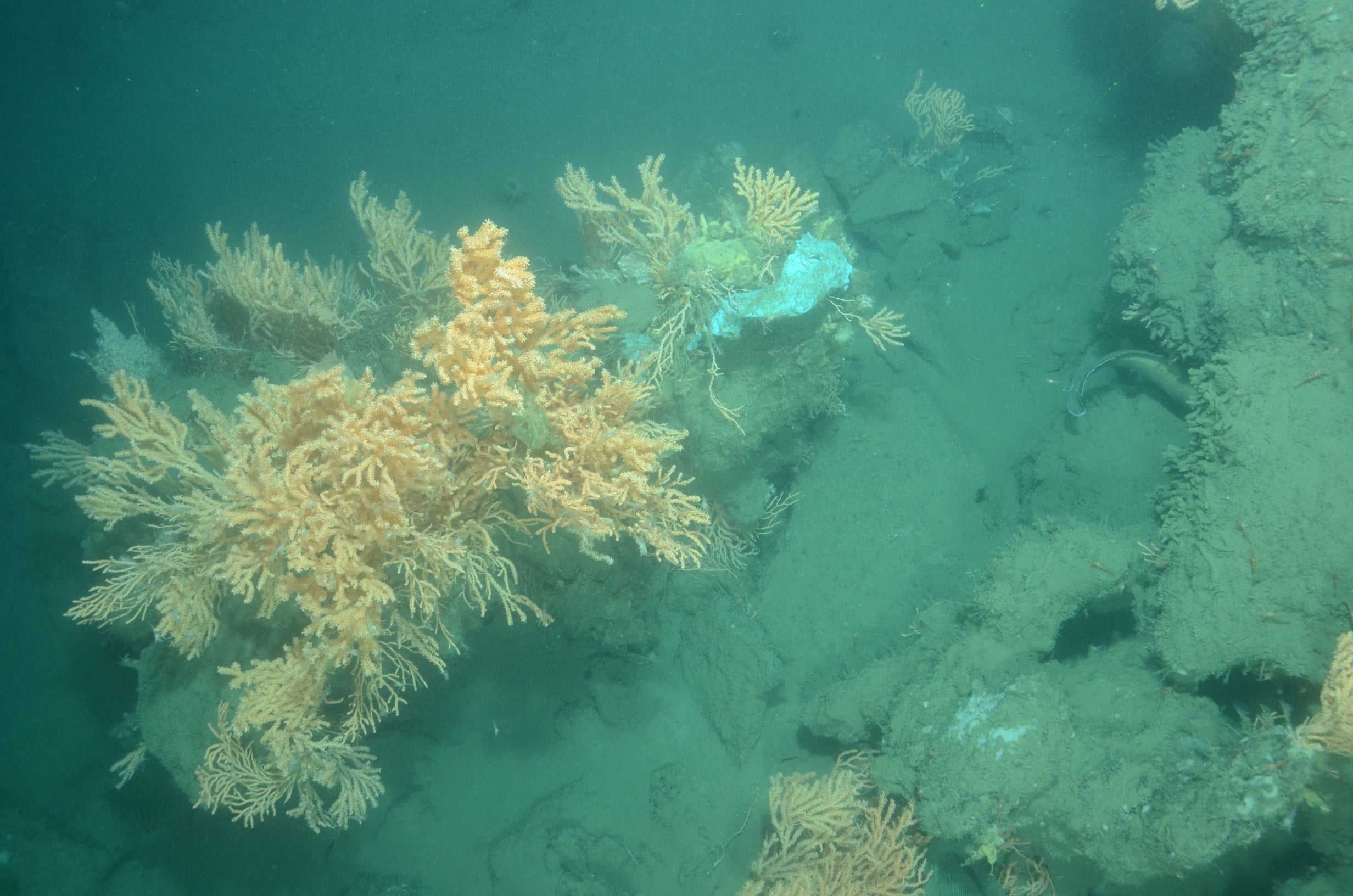
Introduction by Kisha Santiago-Martinez, Chair, MARCO Management Board, and Deputy Secretary of State for Development, Planning, and Community Infrastructure at N.Y. State Department of State.
Tim Shank, Associate Scientist and Deep-sea Biologist, Woods Hole Oceanographic Institution, will share images, videos, and insights from seafloor canyons off the U. S. East Coast that contain dramatic topography, diverse ecosystems, and abundant life, much of which is hidden from view beneath the ocean surface.
Research partly funded by MARCO and the Gordon and Betty Moore Foundation
REGISTER: http://Go.whoi.edu/marco
For guests who can’t access Zoom, email: jtucker@legacy.midatlanticocean.org
Join us for a three part series exploring life in the deep sea. Pre-eminent scientists from around the Mid-Atlantic region will guide us on a tour of unique and exciting species living in extreme conditions far below the surface. We will explore the animals that live there and how they use both natural and man-made habitats to aid in their survival. From crustaceans and corals to sharks and whales, this is one webinar series you won’t want to miss!
Featured Speakers:
Canyon Landscapes and Species Interactions
- Dr. Peter Auster, Research Professor Emeritus of Marine Sciences, University of Connecticut and Senior Research Scientist, Mystic Aquarium
Canyons, Chondrichthyans and Conservation
- Merry Camhi, Director, New York Seascape, Wildlife Conservation Society, New York Aquarium
REGISTER

Are you a newcomer interested in a Portal 101 session or a returning user who could use a refresher course? Then this webinar is for you!
Join us Tuesday, Sept. 15, from 11 a.m. to noon for a #HowTu lesson on our data, tools and features. Come with your list of questions and learn how to map the Mid-Atlantic in this interactive session.
This webinar is free and open to the public. To register, please email Karl Vilacoba at kvilacob@monmouth.edu.
You can find this event on the Portal event calendar.
The Mid-Atlantic Fishery Management Council’s October meeting will be held October 5-8, 2020. The meeting was originally scheduled to be held in Riverhead, NY. Due to ongoing concerns about COVID-19 and public safety, the meeting will be held via webinar. Briefing materials will be posted below as they become available. AGENDA
Questions? Contact Mary Sabo at msabo@mafmc.org, (302) 518-1143.
Public Comments
Written comments must be received by 11:59 p.m. on September 23, 2020 to be included in the briefing book. Comments received after this date but before 5:00 p.m. on October 1, 2020 will be posted as supplemental materials on the Council meeting web page. After that date, all comments must be submitted using an online comment form available at https://www.mafmc.org/comments/october-2020-public-comments.
Join us for a three part series exploring life in the deep sea. Pre-eminent scientists from around the Mid-Atlantic region will guide us on a tour of unique and exciting species living in extreme conditions far below the surface. We will explore the animals that live there and how they use both natural and man-made habitats to aid in their survival. From crustaceans and corals to sharks and whales, this is one webinar series you won’t want to miss!
Featured Speaker: Steve Ross, Research Professor, Center for Marine Science, University of North Carolina – Wilmington
REGISTER